


Consignments invited at Toomey & Co. Auctioneers, a Chicago auction house that handles Fine Art, 20th Century Design, Decorative Arts, Silver, and Jewelry.
Artist: Keith Haring

Keith Haring
1958–1990
Keith Haring was a defining artist of the 20th century: through social engagement, democratizing access to art, and the immediacy of his visual language, Haring shaped the artistic landscape of the 1980s and paved the way for the prominence of contemporary street art.
Free Evaluation


I am intrigued with the shapes people choose as their symbols to create a language. There is within all forms a basic structure, an indication of the entire object with a minimum of lines that become a symbol. That is common to all languages, all people, all times.
Keith Haring


Things to Know About Keith Haring
Haring moved to New York in 1978 to attend the School of Visual Arts. He was expelled the next year for creating graffiti art in a classroom with Jean-Michel Basquiat.
In 1986, with the help of 900 children, Haring painted the 90' x 30' banner CityKids Speak on Liberty to celebrate the 100th anniversary of the Statue of Liberty.
Haring's iconic "radiant baby" was inspired by his religious upbringing and is meant to emulate the innocence of the Christ-child and the rays often surrounded the Virgin Mary. Haring once remarked: "There is nothing negative about a baby, ever."
Haring was part of New York City's thriving downtown scene, frequenting Club 57 and the Mudd Club and befriending Andy Warhol, Madonna, Grace Jones and others. However, he was always committed to his work and its social impact over the party scene.
The final mural he painted, Tuttomundo ("All World") is located in Pisa on an exterior wall at the Church of Sant’Antonio Abate and is dedicated to universal peace.
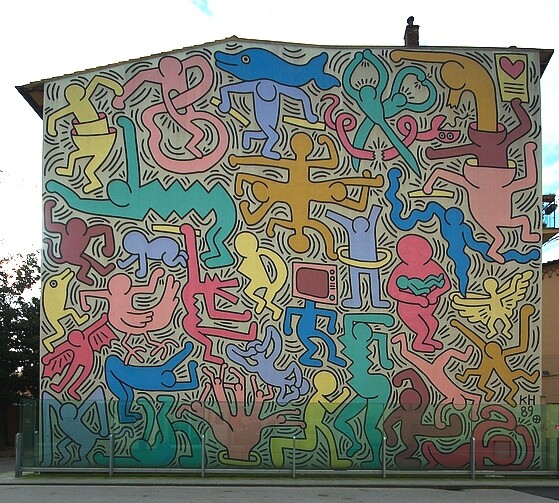


I don’t think art is propaganda; it should be something that liberates the soul, provokes the imagination and encourages people to go further. It celebrates humanity instead of manipulating it.
Keith Haring


The person who created these works certainly cared deeply about the connections between living things, but he also cared about color and line, open and defined space, chaos and clarity. He put all his experience of the world into his art – in the hope that he could communicate at both a visceral and intellectual level with the broadest possible audience.
Julia Gruen, Director, Keith Haring Foundation
Keith Haring 1958–1990
Keith Haring was born in 1958 in Reading, Pennsylvania. From a young age he enjoyed drawing, especially Disney characters and other cartoons. He initially wanted to become a commercial artist but after a year at the Ivy School of Professional Art in Pittsburgh, Haring dropped, moved to New York City and enrolled in the School of Visual Arts (SVA). Haring immediately felt connected to the thriving alternative arts scene happening downtown in the late 1970s and became friends with Jean-Michel Basquiat and Kenny Scharf.
Inspired by the ideals of “art as life” and moving the art experience out of galleries and into the streets, Haring’s first major works were his subway drawings. Haring produced over one hundred of these public works between 1980 and 1985, integrating his now-iconic exuberant, cartoonish outlined figures into everyday public space in a way that directly engaged its viewers. Haring recalled that the most important aspects of these works was the immediate engagement people had with them, asking him “what does it mean?” and giving him feedback that he’d then incorporate into future drawings. In this way, these works became reflections of the people who viewed them, responsive to and in dialogue with their environment. These works quickly garnered the attention of tastemakers in New York and his first solo exhibition was held at Westbeth Painters Space in 1981 and a celebrated show debuted at the high-profile Tony Shafrazi Gallery in New York the following year.
Throughout the 1980s, Haring was committed to democratizing the art experience and along with paintings, he also created theater sets, billboards, murals, advertising campaigns and even a line of Swatch watches. In 1986 he opened the Pop Shop in SoHo, selling apparel, posters and toys bearing his drawings. This was a controversial move, as many galleries criticized Haring for “de-valuing” the art object while others, such as Andy Warhol, championed Haring’s insistence on making art accessible and affordable. Pop Shop was highly influential to contemporary crossovers of art and merchandise that are now so dominant, as in the work of Jeff Koons, Yayoi Kusama, KAWS, Shepard Fairey and Takashi Murakami.
In addition to this ideology of accessibility, Haring was also very socially engaged and used his striking imagery to promote awareness of various political and social campaigns. His many notable public works included a mural on the western side of the Berlin Wall, the Crack is Wack mural in New York, and a mural for the 100th anniversary of the Statue of Liberty in 1986. Haring was diagnosed with AIDS in 1988 and used his presence in the arts community to raise awareness of the crisis. In 1989, a year before his death, he established the Keith Haring Foundation, whose mission is to raise funds for AIDS organizations and children’s literacy and arts programs.
Since his death in 1990, Haring has become one of the most widely-recognized and celebrated artists of the 20th century, priming the path for the rise of graffiti and street art in the 21st century and a socially-conscious approach to talking about sexuality, intimacy and visibility through public art. Famed New York gallerist Jeffery Deitch asserts that Haring made “works that can hang in museums alongside masterpieces…and hold their own as art-historically important pieces,” expressly because they embrace and engage popular culture with an immediate and dynamic visual language that celebrates the joy and chaos of our society.
Keith Haring's subway drawings on CBS in 1982
You don’t have to know anything about art to appreciate it or to look at it. There aren’t any hidden secrets or things that you’re supposed to understand.
Keith Haring


