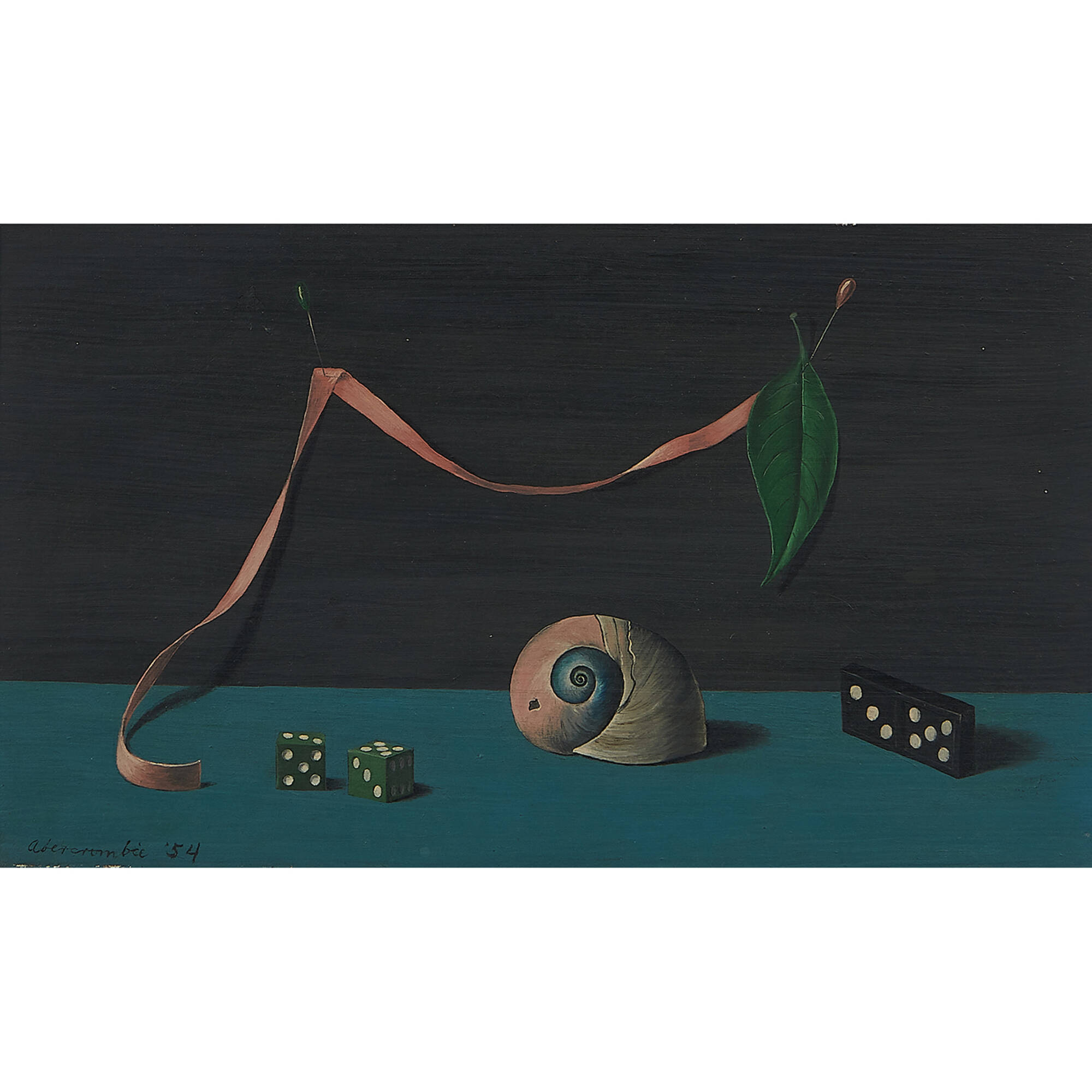
Gertrude Abercrombie (American, 1909-1977) Leaf, Ribbon, Domino, Dice, Shell, Pieces of Eight, 1954 oil on masonite signed and dated lower left 7 1/2 x 12 3/8Provenance: Marshall Field's, Chicago, Illinois, circa 1954Catalog Note: Susan Weininger, the leading scholar and author of multiple comprehensive essays on Gertrude Abercrombie's art and life, has seen and confirmed the authenticity of this work. Abercrombie began to do still life paintings incorporating shells, eggs, leaves, ribbons, acorns, drapes, and other personally significant objects in the early 1950s. Leaf, Ribbon, Domino, Dice, Shell, Pieces of Eight from 1954 is one of many that she did in the mid 1950s, when this kind of work dominated her oeuvre. All of them are unique, engaging, and absorbing works which show the wittiness and mystery, as well as the perfection of composition, characteristic of the artist. This painting, with its descriptive yet clever title, was, according to my records, sold at Marshall Field's gallery in 1954 or 1955. At this time, a number of major department stores had serious art sales galleries and Abercrombie frequently exhibited in them. In 1954, she had a one person show at Field's at which this work was exhibited. Although Abercrombie did still life paintings early in her career, her work in the 1930s and 1940s was dominated by portraits, landscapes, and interiors, with or without figures (almost exclusively self portraits) replete with objects that had personal meaning for her. In the early 1950s, probably in an effort to generate some income that was needed after her divorce and remarriage in 1948, she began doing very small (1 x 1 or 1 1/2 x 1 1/2) paintings that could be made into pins. These were primarily simple still life paintings, often shells. At about this time, she also begins to create the more complex and larger still life paintings that are typical of this period. Unlike the still life work she produced earlier in her career, which are complicated and painterly, these are characterized by minimal detail, almost undetectable brushstrokes, and clear, bright colors. They attest to Abercrombie's evolving style and skills, while retaining the mastery of composition and witty approach to her subjects. And they are, as I stated above, unique creations — unless there was a special reason, Abercrombie did not copy herself. In Leaf, Ribbon, Domino, Dice, Shell, Pieces of Eight, Abercrombie has arranged the objects on a blue-green ground against a dark backdrop. The shell, dice, and domino are arranged on the ground, while the leaf and ribbon are pinned on the backdrop with the hatpins that Abercrombie used regularly for this purpose. The end of the ribbon descends gracefully down to the ground, connecting the two parts of the painting. The composition is balanced using color: the pinkish color of the top left part of the shell seems to reflect the pink ribbon and the pink hatpin on the right side, while the leaf and dice subtly echo the green hatpin to the left. Similarly, the positions of the elements in space create enough dynamic interest so the painting is not dull. Abercrombie's mastery of traditional composition and techniques such as chiaroscuro are often overlooked, but it is made clear in paintings such as this one, which has a jewel-like perfection in the placement of solid three-dimensional objects in space. Abercrombie stressed the importance of ideas over technique in making art, stating, 'Something has to happen, and if nothing does, all the technique in the world won't make it,' and this is clear even in a simple still life such as this one. First, these are her own objects, giving them a meaning far beyond their neutral existence as things. She loved games, as the domino and dice suggest; the shell in the image appears in innumerable paintings as do the leaf and ribbon. This imbues the work with a personal resonance that is part of all of her paintings. Second, the title points to the distinctive Abercrombie humor that she injects into many of her images. There are no pieces of eight in the painting, but the domino displays eight dots and the dice show a total of eight on both sides. The number of objects in the painting also total eight (I thank John Walcher for this insight). Like so many of Abercrombie's paintings, this one appears simple but yields more than a pretty and well-composed painting. It is, like almost all of her works, a kind of self portrait, alluding to the games she loved with a title that is part of the game. — Susan Weininger