Louis Ritman 1889–1963
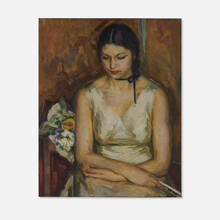
An American Impressionist painter celebrated for his luminous depictions of women in gardens and richly colored interiors, Louis Ritman was born in Kamenets-Podolski in the Russian Empire in 1889. He immigrated with his Jewish family to Chicago as a child around 1900. Growing up in modest circumstances, he worked as a sign painter to help support his family while studying art at Hull House, the School of the Art Institute of Chicago, the Chicago Academy of Fine Arts, and briefly at the Pennsylvania Academy of the Fine Arts. His remarkable artistic talent earned him scholarships and the mentorship of artist Lawton Parker, who encouraged him to continue his studies in Paris.
In 1909, Ritman moved to Paris and enrolled at the Académie Julian and the École des Beaux-Arts. Through Parker, he became associated with the American expatriate painters working in Giverny, including Frederick Carl Frieseke and Richard Miller. Beginning in 1911, Ritman spent many summers in Giverny, where he developed the vibrant Impressionist style that would define his early career. His paintings often featured elegantly posed women, clothed or nude, surrounded by flowers and bathed in dappled sunlight. Critics admired the brilliance of his color, decorative compositions, and energetic brushwork, which placed him among the leading members of the second generation of American Impressionists.
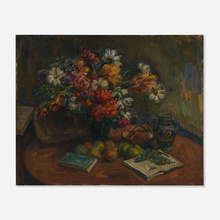
During the 1910s and 1920s, Ritman exhibited widely in Paris, New York City, and Chicago, earning praise for his technical skill and radiant treatment of light. Over time, his work evolved under the influence of Paul Cézanne, and his paintings began to emphasize stronger structure, broader brushstrokes, and richer tonal contrasts. Although he continued to paint figures and interiors, his later works moved away from pure Impressionism toward a more solid and expressive style. Ritman received numerous honors throughout his career, including awards from the Art Institute of Chicago and election to the National Academy of Design.
In 1929, Ritman returned permanently to the United States and began a long career teaching portrait and figure painting at the School of the Art Institute of Chicago, where he remained for nearly three decades. While continuing to travel to France during the summers, he also expanded his subjects to include landscapes and still lifes inspired by the countryside of Michigan and the Midwest. Ritman retired from teaching in 1959 and later settled in Winona, Minnesota, where he died in 1963. Today, Ritman's paintings are held in major American museum collections and he is remembered as one of the foremost American Impressionists associated with Giverny.