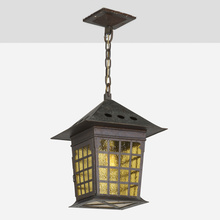
Gustav Stickley, Early plant stand, model 41 - Image 1 of 3
Gustav Stickley, Early plant stand, model 41 - Image 2 of 3
Gustav Stickley, Early plant stand, model 41 - Image 3 of 3
149

Gustav Stickley 1858–1942

Early plant stand, model 41

USA, c. 1902
oak
28 h × 14 w × 14 d in (71 × 36 × 36 cm)
estimate: $1,000–1,500
result: $2,261

Faint remnant of original decal to underside.
provenance: The Goldstein Family Collection
literature: 1902 Retail Plates, manufacturer's catalog, unpaginated

This work will ship from Lambertville, New Jersey.

print

When a man's home is born out of his heart and developed through his labor and perfected through his sense of beauty, it is the very cornerstone of life.

Gustav Stickley

A Forty-Year Love Letter
to California Light and Form

by Scott Goldstein, Los Angeles, California

Exterior view of the Goldstein Residence at 111 S. Van Ness Avenue in Los Angeles
Exterior view of the Goldstein residence at 111 S. Van Ness Avenue in Los Angeles
(Video courtesy of Hancock Homes Realty / John Duerler)

View the Goldstein Home

When I brought my very first piece of California Arts & Crafts into my home forty years ago, I did not realize I was embarking on a four-decade romance. At the time, the Arts & Crafts collecting world was deeply and deservedly enamored with the East Coast movement. We all revered Gustav Stickley's fumed-oak, irresistible magnetism—its structural "truth," its basic geometry, and its quiet, disciplined dignity. Stickley’s legendary motto, Als Ik Kan—"To the best of my ability"—was stamped onto his work as a fierce vow of labor, duty, and functional simplicity. It was a magnificent, seductive response to the cold advent of the machine age.

But when I encountered the craftsmen—and especially the craftswomen and artists—of the West Coast, something entirely different woke up inside me. Where Stickley brought a beautiful, rigorous discipline to design, California brought poetry. The late curator Ken Trapp and Leslie Bowman beautifully captured this regional spirit when they coined the phrase that defined the California movement: "Living the Good Life." Out West, the philosophy shifted those hallmarks of medieval-style artisanship of the guild workshop and idealistic lifestyle by deepening and expanding them. Simple living and sincere artistic thinking were perfectly paired with the neo-romantic landscapes of the Pacific Coast. It was not just the majestic redwood forests or the use of native woods but also included other aspects. There were philosophical elements that were, in a sense, "inborn" to the region—the gentle play of sunlight on the early spring bloom of California poppies and lupines, to name just one. It was a landscape so breathtaking that painters of the plein-air movement simply could not resist going out into nature to record their impressions with oil on canvas.

But when I encountered the craftsmen—and especially the craftswomen and artists—of the West Coast, something entirely different woke up inside me. Where Stickley brought a beautiful, rigorous discipline to design, California brought poetry.

For these forty years, I have lived surrounded by this poetry. I have watched the changing daily light catch the hand-beaten facets of Dirk van Erp copper, transforming a simple room into a warm hearth. I have run my fingers over the expressive, hand-carved details and painted native flora and figures of Lucia and Arthur Mathews' furniture, which felt less like utilitarian structures and more like three-dimensional canvases. I found that same synthesis in Elizabeth Eaton Burton's and her father Charles Eaton's lighting, with their rustic elegance combining elements of land, sea, and sky, often all at once. While the East Coast gave us the strength of the anvil and the ultimate expression of oak, and Frank Lloyd Wright mirrored his architecture with the heartland prairie, in southern California I saw and sensed the warmth of the Pacific sun with its marine-layered atmospheric effects, and the fluidity of Japanese joinery lovingly executed in redwood, ash, and Port Orford cedar. The vibrant colors of the wildflower spring bloom and the textures of the entire region's natural world were deeply imprinted into this decorative art. This was the brief, radiant genius of artists who were unafraid of being different or even unique, and who generously shared their very personal expression of beauty.

Living with these pieces has been nothing short of a privilege. They have not been a "collection" tucked away in glass cases or dark storage facilities; they formed the literal interior of a home. If the artists could have witnessed this decades-long integrated environment—the morning coffees, the nighttime conversations gently lit by table lamps that married Grueby bases to Tiffany shades, or by the magical glow of creators like Elizabeth Eaton Burton, Dirk Van Erp, D'Arcy Gaw, and Lilian Palmer, the painted wood of Lucia Mathews, the graphic art of Florence Lundberg, and the all-encompassing work of Charles and Henry Greene—I believe they would all be pleased. These objects were, in a sense, active "participants," present for the changing seasons and a home built around that California ethos and the human hand.

If the artists could have witnessed this decades-long integrated environment [...] I believe they would all be pleased. These objects were, in a sense, active "participants," present for the changing seasons and a home built around that California ethos and the human hand.

Now, the time has come to pass the proverbial torch. Saying goodbye to the collection that defined my family's surroundings for four decades is an emotional milestone. But whatever sadness may remain is entirely eclipsed by gratitude. I always believed that we do not truly "own" inspirational works of art like these; we are but temporary caretakers. And so, too, I am grateful to the teams at Rago and Toomey & Co. for bringing this journey full circle in Lambertville where this collection—deeply rooted in the inspirational craftsmanship of the American East and the wild imagination of the West—will find its next caretakers.

I cannot help noticing that the anxiety that birthed this entire movement—the worrisome advent of the machine age—finds its echo in our own 21st-century landscape of artificial intelligence, digital abstraction, and uncertainty. As our world becomes increasingly intangible, floating precariously on screens and algorithms, that historic simplicity, material honesty, and the undeniable human thumbprint of these pieces offer a timeless sanctuary. It is my hope that as they leave my home, they bring the very same warmth, comfort, and golden California light and form into yours.

A Note from David Rago

Suzanne Perrault and I first met the Goldstein family in 1989 while exhibiting at Sandy Smith's Modernism show in Manhattan. We became frequent house guests and remained close friends through the ensuing decades. I had the pleasure of watching the children grow and the collection take shape. Much of the collection, but not all of it, was purchased from West Coast dealers because of a particular focus on California Arts & Crafts. But it was a learning experience for me as I was able to view exceptional work up close in a beautiful home setting. The centerpiece was the house itself, a 1912 California Arts & Crafts "Craftsman bungalow," once lived in by Will Rogers.

Particularly concerning friends, one never thinks such an assemblage will come to market or that you will be the one to sell it. Suzanne, John Toomey, and I are honored to have been entrusted with these wonderful objects and proud to present this collection as part of our fall auction series.

Gustav Stickley 1858–1942

Gustav Stickley, whose name is synonymous with Craftsman furniture, was a visionary American proponent for the Arts and Crafts philosophy in design, literature, and life. At the peak of his career, his furniture was sold throughout the country, Craftsman houses built in many areas, and The Craftsman magazine widely read. After bankruptcy in 1915, Stickley was largely forgotten until the 1970s, when his importance as a designer was rediscovered by a new generation.

The eldest son of first generation German immigrants, Stickley was born into a family that owned furniture-manufacturing businesses. He found inspiration in the writings of John Ruskin and William Morris and the well-built, hand-crafted furniture and the brotherhood of honest labor they espoused. In 1898 he established the Gustav Stickley Company in Eastwood, a suburb of Syracuse, New York. He adopted a William Morris motto, "Als ik kan" ("If I can") and used the symbol of a medieval joiner’s compass as his trademark.

Stickley’s furniture was a radical departure from the American furniture of the Victorian era. Surfaces were unadorned, mortise and tenon joinery and wood grain exposed. The hammered metal hardware underscored the artisanal look of furniture, which was fabricated both by hand and by contemporary woodworking machines.
Stickley expanded his activities constantly. He changed the name of his company to The Craftsman Workshops and marketed his product with the brand name “Craftsman”. Ultimately over 100 retailers across the United States represented the brand. In 1903, he announced his “Home Builders Club”. In 1908, he built a great home in New Jersey called Craftsman Farms. In 1909 he formed the Craftsman House Building Company. He was an American success story, a nationally known figure with money, influence and a loving family. In addition to furniture, Stickley published The Craftsman (1901–16), a periodical and his “Bible” for promoting the Arts and Crafts philosophy, his products, and house designs by leading architects.

But Stickley overextended. He leased an expensive headquarters in New York City — the Craftsman Building — to house his empire just before the outbreak of World War I. Interest in the Arts and Crafts movement waned and competition increased, even from his own brothers, all of whom were manufacturing furniture in the Arts and Crafts style. Leopold and John George had established the successful firm of L&J.G. Stickley. Albert, along with John George for a time, ran Stickley Brothers Company. Charles also sold Arts and Crafts furniture.

In 1915 Stickley, deep in debt, filed for bankruptcy. He ceased publication of The Craftsman and sold Craftsman Farms. His brothers brought him into a new venture called Stickley Associated Cabinetmakers, absorbing The Craftsman Workshops. Gustav Stickley moved back to Syracuse where he lived until his death in 1942.

Auction Results Gustav Stickley