Ethel Leichti was a pioneering collector of mission furniture in the 1960s, while a graduate student at UCLA. She would go on to play a critical role in drawing attention to designer and craftsman Gustav Stickley, beginning with advocating for his inclusion in The Metropolitan Museum of Art's Nineteenth Century America: Furniture and Other Decorative Arts in 1970, and subsequently lending several important pieces for public display. Ethel retired to Oak Park in 2005, where she kept her 1923 brick bungalow fully furnished with Gustav Stickley furniture until her death.
—Ruth Crisler, Ethel's daughter

Robert Jarvie 1865–1941
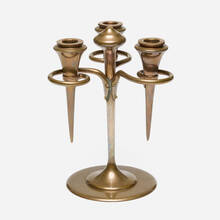
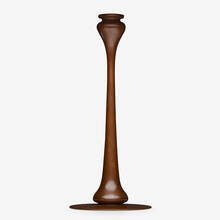
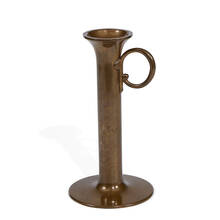
Born to Scottish parents in Schenectady, New York in 1865, Robert Riddle Jarvie was not formally trained in metalsmithing, but he had an early penchant for sketching, bookbinding, and cabinetmaking. Once he relocated to Chicago, Jarvie began initial experiments with metalwork around the turn of the 20th century in his apartment. In particular, a distinctive lantern that Jarvie made for a friend attracted more buyers. At the Third Annual Chicago Arts & Crafts Exhibit in 1900, Jarvie had the first opportunity to showcase his work. That same year, he became a partner at Krayle Co., a commercial and social alliance of local artisans and craftsmen, and set up his studio, the Jarvie Shop, in Chicago's Fine Arts Building on Michigan Avenue.
While Jarvie's designs had previously ranged from Colonial to Art Nouveau, he soon developed simpler organic forms that represented a Midwestern take on the Arts & Crafts Movement. Between 1910 and 1915, Jarvie began forging products using precious metals such as gold and silver that garnered wide acclaim. Charles Hutchinson, President of the Art Institute of Chicago, commissioned Jarvie to produce a silver punch bowl for the Cliff Dwellers Club of Chicago, as both men were members; Jarvie modeled his design on an object used by Southwestern cliff dwellers that he had seen at Chicago's Field Museum of Natural History.
In 1912, Jarvie started creating functional trophies such as bowls, drinkware, and other forms for the Union Stock Yard Company. Jarvie also lived on the premises. Some of his holloware and flatware designs from this period are reminiscent of Paul Revere's style. Jewelry by Jarvie is extremely rare and only seven works are known to exist. After World War I, the Jarvie Shop ceased operations. Jarvie and his wife then moved to Evanston, Illinois, since she was employed at Northwestern University, and Jarvie worked briefly for the C.D. Peacock Company.
The Jarvies later retired to the Scottish Old People's Home in North Riverside, Illinois until their passing. During the Arts & Crafts revival of the late 20th century, collectors developed a renewed appreciation for the metalwork of Jarvie. Today examples by Jarvie are included in the collections of the Art Institute of Chicago, the Milwaukee Art Museum, the Museum of Fine Arts in Boston, and elsewhere.