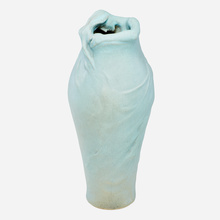
Many competent critics regard Grueby ware as the highest achievement of the potter's art in this country. It has a distinct individuality in character and tone ... relying for its effect ... on the super finish of its surface, on the subdued richness of its colors, and on the ideas embodied in its designs.
Walter Gray, "Latter-Day Developments in American Pottery," Brush and Pencil, January 1902
Grueby is a name synonymous with the American Arts & Crafts Movement and a marker of exceptional quality.
Grueby Faience Company was established in 1894 by William Henry Grueby. A great admirer of the matte glazes of French pottery and the refined simplicity of Japanese ceramics, Grueby founded his company with the intent of creating works of ceramic art that folded these two influences into a singular design philosophy that was wholly American. The bulk of Grueby’s creations were works of art pottery, though the company was also highly regarded for their production of some of the best architectural tiles in America.
The aesthetic of Grueby pottery has been described as ‘organic naturalism’ and can be identified by two defining characteristics: form and glaze. Most Grueby pottery features vegetal shaped forms, often bulbous and gourd-like, adorned with stylized foliate designs that were either placed above or carved into the vessel’s surface. The majority of these pieces were glazed in a matte cucumber green that would come to be the company’s hallmark. Other Grueby glazes exist, including light blue, soft yellow, and a handful of other earthen hues, though none of these are as quintessentially “Grueby” as the deep woods green seen on most of the manufacturer’s pieces.
Grueby pottery and tiles enjoyed great popularity in the late 19th and early 20th centuries and were sold in fine design shops from Paris to New York City. Grueby even landed a partnership with Tiffany Studios, producing lamp bases for the renowned lighting and glass manufacturer. Before long, Grueby became a victim of its own success, inciting mass-market competition that led the company to declare bankruptcy in 1909. Grueby emerged from bankruptcy but was shut down shortly after due to a fire in their manufacturing wing. Grueby was able to rebuild, but the weight of tragedy had begun to take its toll. The company closed its doors for the last time in 1920.
In the modern secondary art market, pottery and architectural tiles by Grueby are highly collectible and sought after. Innovative in design, delightful in form, and steeped in history, Grueby pottery and tiles are true American treasures.
In 1872, Samuel A. Weller established Weller Pottery in Fultonham, Ohio, with a modest cabin and a single kiln. Weller's expansion to Zanesville, Ohio in 1882 signaled the onset of decorative ware production. Inspired by the Lonhuda Pottery from Steubenville, Ohio on display at the 1893 Chicago World's Fair, Weller collaborated with Lonhuda's William Long to create the Louwelsa faience line and likewise absorbed Lonhuda into Weller altogether. Following Long's departure in 1896, the line was renamed after Weller's daughter, Louise.
Many notable pottery artisans graced Weller over the years. From 1895 to 1904, Charles Babcock Upjohn contributed to popular Weller lines like Dickensware I, Dickensware II, Eocean, and Corleone. Jacques Sicard and Henri Gellie undertook the challenging development of the Sicardo line, with its distinctive metallic glaze, between 1902 and 1907. Frederick Hurten Rhead briefly joined Weller in 1904 before moving to Roseville Pottery. That same year, participating in the 1904 St. Louis Exposition, Weller expanded its repertoire further. Initially known for crafting utilitarian items, such as flower pots and bowls, Weller evolved into the largest pottery in the United States by 1905. Rudolph Lorber introduced lines like Dechiwo in 1908, which was followed by Brighton birds, Muskota, Woodcraft, Forest, and Coppertone, which features whimsical frogs and fish. Dorothy England Laughead also contributed Silvertone, Chase, and Garden Animals.
In 1922, Weller Pottery underwent incorporation as "S.A. Weller, Inc." Following Samuel A. Weller's passing in 1925, his nephew Harry Weller assumed leadership. Faced with financial challenges during The Great Depression, the company consolidated plants in 1931. Weller Pottery continued with simplified embossed lines from 1935 until its closure in 1948, managed by Walter Hughes and under the control of Essex Wire Corporation.
In retrospect, the Weller legacy encompasses innovative art pottery production as well as controversy regarding its founder's reputation for acquiring designs. Weller Pottery's history reveals collaborations with prominent figures, occasionally tumultuous relationships, and a transition toward making commercial wares. Nonetheless, collectors of American Arts & Crafts art pottery continue to appreciate various Weller lines and inspired examples often command high prices at auction or via private sale.