In 1903, architect Harvey Ellis oversaw the installation of Gustav Stickley's large Arts & Crafts exhibition at the Mechanics Institute in Rochester, New York. Subsequently, Ellis relocated to Syracuse and joined the architecture department within Stickley's United Crafts organization. Ellis likewise began to write articles on architecture and interior design and produced artwork for Stickley's influential journal, The Craftsman. While Ellis would die prematurely of heart disease at the age of fifty-one on January 2, 1904, the seven or eight months that he worked for Stickley made an outsized impact on the American Arts & Crafts Movement.
Although Ellis spent much of his life in Upstate New York, he did serve as an architect for various firms throughout the Midwest for seven years prior to working for Stickley. In addition, some of Ellis' earlier watercolor sketches of French landscapes suggest that he might have traveled there in 1885. Otherwise, while Ellis might not have had the broadest geographic horizons, he was a genuinely adventurous thinker who leveraged theories and aesthetics from traditional Japanese design along with disparate European Arts & Crafts styles, including the work of British architects Baillie Scott and Charles Francis Annesley Voysey, Scottish architect Charles Rennie Mackintosh, and the multitalented architect, designer, and Wiener Werkstätte co-founder Josef Hoffmann.
The brief time that Harvey Ellis worked for Gustav Stickley is considered by many to be the stylistic peak of Stickley furniture. Forms attributed to Ellis have a generally lighter touch than most Stickley works before and after. Ellis is thought to have incorporated curved lower edges on horizontal rails in some cases, which creates the effect of furniture blending more fluidly into the floor. In addition, Ellis-inspired designs very often include purely decorative wood and metal inlays.
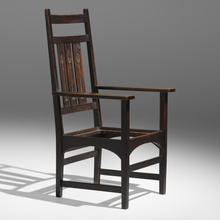
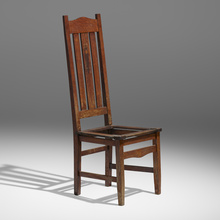
There are several compelling details that suggest the present chair design may be attributed to Harvey Ellis. Most notably, the copper and pewter inlays featuring stylized flower pods with gracefully elongated stems are characteristic of Ellis’s decorative sensibility. The arched seat rails and the overall lighter, more refined structure likewise reflect the aesthetic departures he introduced during his time with Stickley. Another example of this design is held in the collection of the Two Red Roses Foundation, which is illustrated in Arts and Crafts Furniture from the Collection of the Two Red Roses Foundation by David Cathers and Susan Montgomery. While definitive attribution remains elusive, the visual evidence and design features point strongly toward Ellis’s hand—or at least his influence—at the height of his creative collaboration with Stickley.


When a man's home is born out of his heart and developed through his labor and perfected through his sense of beauty, it is the very cornerstone of life.
Gustav Stickley